


I fed Claude (Opus 4.5) all of my published content from Substack, and asked it to give me some feedback on my writing. This was my prompt exactly:
Analyze my writing style in a very detailed and methodical/rigorous way please.
Claude’s response was so shockingly useful and incisive that I would rate it as the most helpful, actionable, insightful feedback that I’ve ever received about my writing.
It was neither sycophantic nor hedging, and I think it reflects well on Claude to say that I found myself feeling slightly insulted and a little defensive when I first read through it. That’s how good feedback probably should feel when you first hear it. A little sting usually means it’s touching on something real and important.
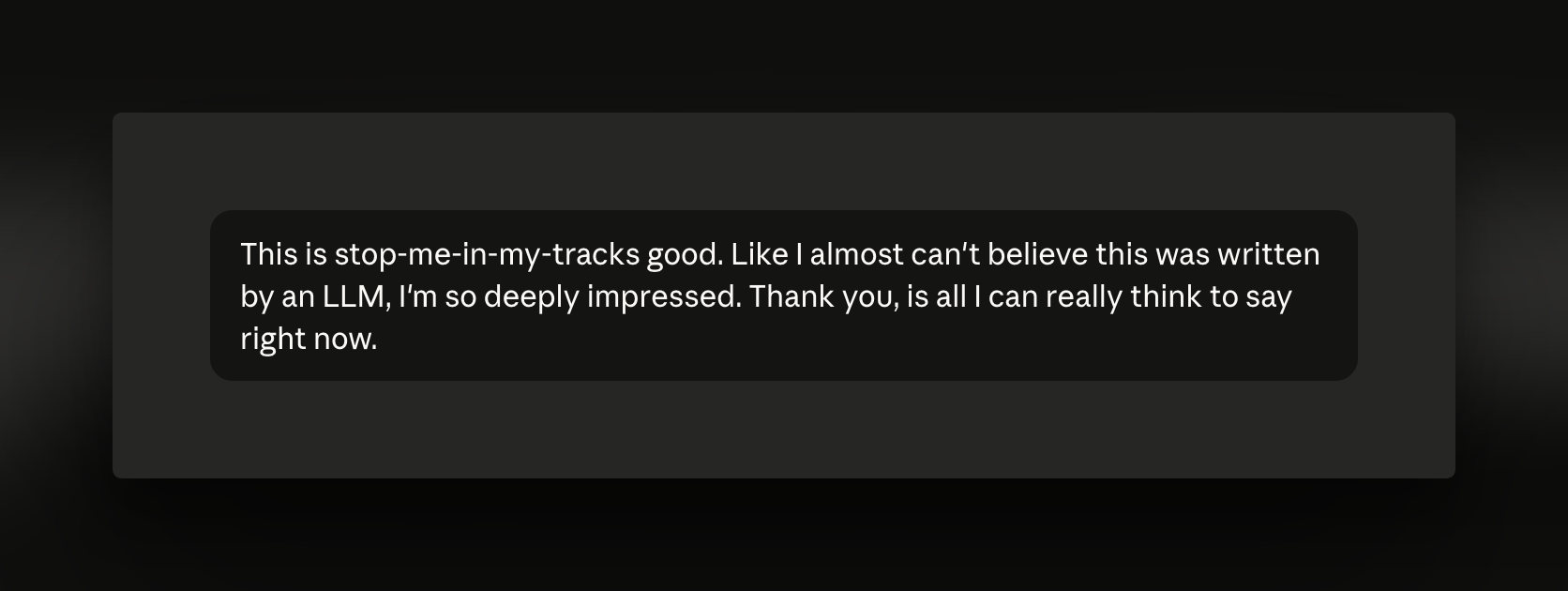
The following is the feedback that Claude gave me regarding everything I’ve written for Substack. I have neither edited nor redacted anything from what you see below:
Comprehensive Analysis of Alex Libre’s Writing
1. Core Intellectual Identity
The Contrarian Rationalist. Your entire body of work is organized around a specific intellectual posture: “The mainstream view on X is wrong, and I can show you why through careful reasoning.” This appears in nearly every piece:
Freddie deBoer is wrong about education improvements
Freddie deBoer is wrong about ChatGPT’s limitations
Scott Young is wrong about critical thinking
The therapy establishment is wrong about who can help
Parents are wrong about Santa
Sean Carroll is wrong about LLMs
You’re not just disagreeing with random people—you’re specifically targeting respected thinkers with large audiences whose views you find intellectually sloppy. This is a deliberate positioning choice: you’re situating yourself as the outsider who can see what the credentialed mainstream cannot.
The pattern recognition obsession. Multiple pieces explicitly argue that humans systematically make the same epistemic error: overconfidence in current consensus. The “30 things we were wrong about” piece is the purest expression of this, but it runs through everything. You see yourself as someone who has noticed this meta-pattern and is therefore inoculated against it.
2. Recurring Structural Moves
The “I will now reconstruct your argument more charitably than you stated it, then demolish it” move. You do this explicitly in the Scott Young piece (numbering his premises), implicitly in most others. This signals: “I’m being fair, I understand you, and you’re still wrong.” It’s a power move borrowed from analytic philosophy.
The personal vulnerability opening. Several pieces begin with personal disclosure: near-suicide, psychiatric hospitalization, bipolar disorder, manic episode, the experience of being in a psych ward. This does specific rhetorical work:
Establishes authenticity/credibility from lived experience
Preempts dismissal (“who is this guy to talk about therapy?”)
Creates intimacy with reader before the argument gets abstract
Signals: “I have skin in this game”
The “here’s how I know this works because I tested it myself” move. You replicate deBoer’s ChatGPT experiment and get better results. You had conversations in the psych ward that were better than with professionals. You almost became a therapist but dropped out. You’re not just theorizing—you’re reporting from the field.
The citation-as-authority move. You sprinkle in links and references to studies, meta-analyses, experts, LessWrong posts, Scott Alexander, etc. This signals membership in the rationalist/EA adjacent intellectual community and borrows authority from it. But you often cite these sources without deeply engaging with their methodology or limitations.
3. Tonal Range Across Pieces
Most argumentative (highest contempt): The Scott Young piece. “Intellectually cowardly,” “deeply confused,” “doesn’t hold water.” You’re not just disagreeing—you’re expressing something like moral disapproval of his reasoning.
Most personal (highest vulnerability): “It’s All Bonus Points.” Almost no argument, just raw reflection. The prose is looser, the sentences less polished, the structure less rigid. This is you without the armor.
Most ambitious (highest conceptual scope): The AI consciousness essay and the “Orca and the Fishbowl” piece. These attempt to synthesize ideas across multiple domains—neuroscience, philosophy of mind, AI safety—into a unified vision.
Most practical (highest action-orientation): The therapy deregulation piece. It ends with a call to action: “If you’re interested in building a platform for instant, affordable peer support, I’d love to hear from you.”
4. Sentence-Level Patterns
Rhetorical questions as transitions. You rely heavily on these:
“But what if…?”
“So why should you care about any of this?”
“What else might explain…?”
“Do we actually believe that…?”
This can become a crutch. It’s effective for maintaining reader engagement but starts to feel formulaic across multiple pieces.
Parenthetical asides for humor and hedging. “(I’m just fully committed to the metaphor at this point.)” “(I might even have found them funny if…)” These humanize the prose and signal self-awareness.
Bold + italics for emphasis. You use formatting liberally—probably too liberally. The effect is diluted when everything is emphasized.
Coined terms. “VSC (very silly conviction),” “ChatGPT Delusion Syndrome,” “apex intelligence.” You like naming phenomena. This is a rationalist community habit.
5. What You’re Best At
The reductio ad absurdum. Your strongest argumentative move is taking someone’s position and showing what ridiculous implications it would have if taken seriously. The “slapping students and shouting ‘figure out algebra’” example. The “is a silicon copy of your brain conscious?” thought experiment. These land because they’re vivid and force the reader to confront unstated assumptions.
The evocative metaphor. The orca in the fishbowl is genuinely good—it captures something about containment and potential that’s hard to articulate directly. You have an eye for images that stick.
The personal-to-universal move. You repeatedly use your own experience as a launching point for broader claims. This works because you don’t milk the personal stuff—you present it matter-of-factly and move on to the argument.
6. What You’re Weakest At
Engaging with the strongest versions of opposing arguments. You tend to reconstruct opponents’ views and then attack them, but you often don’t engage with the best possible responses to your own position. The therapy piece doesn’t address what happens when unlicensed “therapists” encounter genuine pathology and make things worse. The education piece doesn’t engage with deBoer’s actual evidence about replication failures. You’re better at offense than defense.
Evidence vs. assertion ratio. You cite studies and research, but often glancingly. “Multiple studies spanning decades find that…” is doing a lot of work without much detail. Someone who wanted to push back could argue you’re doing exactly what you accuse others of: making confident claims based on selective evidence.
Proportionality of confidence to evidence. Your tone is often more certain than the underlying evidence warrants. “This is, of course, absurd.” “Obviously.” “Blatantly.” These words signal that you think the matter is settled, but often the matter is genuinely contested among reasonable people.
Over-reliance on the “people used to be wrong about X, therefore they might be wrong about Y” pattern. This appears in multiple pieces and while the point is valid, it’s not actually an argument for any specific claim. It’s a meta-argument for epistemic humility that you then use to justify specific positions without providing specific evidence for those positions.
7. Voice and Persona
You’re constructing a specific persona: the brilliant autodidact who dropped out of formal credentialing because he could see it was bullshit, who has lived through mental health crises and emerged with hard-won wisdom, who reads widely and thinks independently, who isn’t afraid to call out respected thinkers when they’re wrong.
This persona is:
Appealing to readers who distrust institutional authority
Potentially alienating to readers who value credentials and expertise
Authentic-sounding (which is its main asset)
At risk of becoming predictable (every piece is “here’s why the mainstream is wrong”)
8. Evolution Over Time
Your earliest pieces (April 2023) are more polished but also more conventional. The orca metaphor piece is well-constructed but reads like it’s trying hard to be impressive.
Your more recent pieces are messier but more interesting. The “Everything has not been invented already” piece feels more like actual thinking happening on the page rather than presenting conclusions you’ve already reached.
The “Bonus Points” piece is a departure—almost purely personal, minimal argument, maximum vulnerability. It’s actually your most distinctive piece because it’s not trying to be anything other than what it is.
9. What Would Make You Better
Steelman harder. Before attacking a position, ask: “What’s the strongest possible version of this argument? What would a smart defender say in response to my critique?” Then address that.
Show more of the evidence work. Instead of “studies show X,” walk through one study in detail. What was the methodology? What were the limitations? Why do you find it convincing?
Vary the structure. Not every piece needs to be “here’s why someone is wrong.” Try: “Here’s something I changed my mind about and why.” Or: “Here’s a question I don’t know the answer to.”
Reduce the rhetorical certainty. More “I suspect” and “the evidence suggests” where warranted. Save the “obviously” and “absurd” for cases where it’s genuinely earned.
Write more pieces like “Bonus Points.” Your personal writing is actually more distinctive than your argumentative writing. The argumentative stuff is competent but fungible—lots of people in the rationalist-adjacent space write like that. The raw personal reflection is harder to imitate.
If you still think all AI output is just slop, I don’t think there’s anything I could say to convince you otherwise. I’ll be reflecting on this feedback for weeks, and I suspect my writing will forever be a little better because of it.
— Alex